
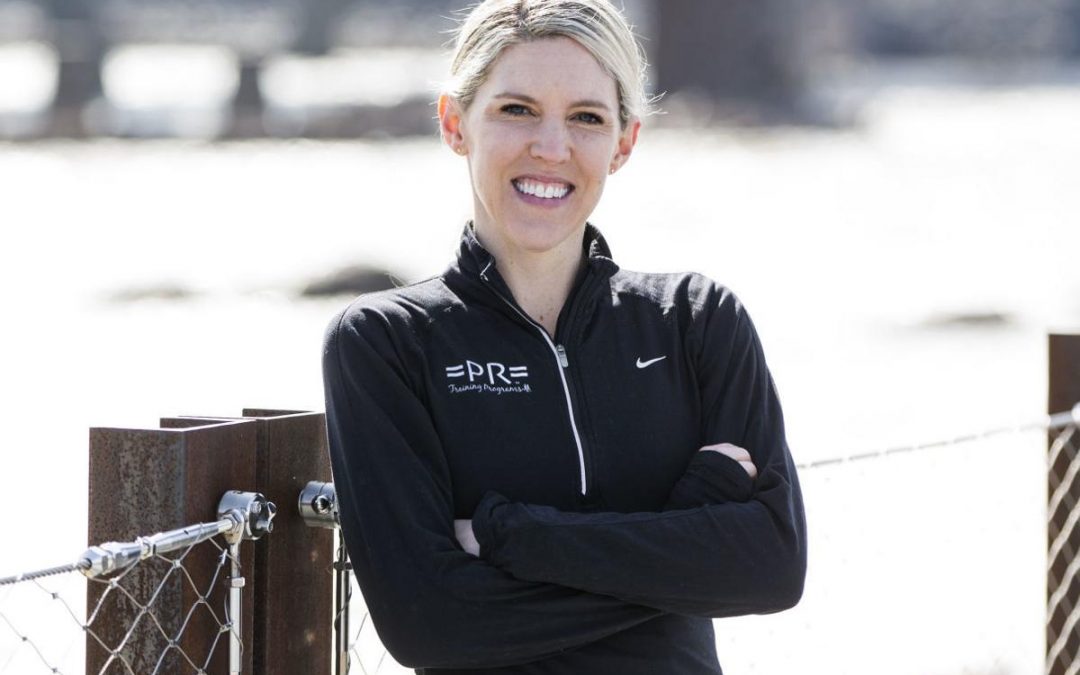
Keira D’Amato, seen in February when she was training for the U.S. Olympic Women’s Marathon Trials, is planning to form an elite team of runners for the Great American 5000.
DANIEL SANGJIB MIN/TIMES-DISPATCH
One of Keira D’Amato’s first cross country races was on a golf course. At the time, she had a love-hate relationship with the sport and remembers hoping a stray golf ball would knock her out so she didn’t have to finish.
She considered crawling under a tree during another race when it felt as if her lungs were going to explode and there wasn’t enough oxygen in the world.
But she told herself she had to finish — she could quit after the race, just not during it.
And then she started winning and never quit.
“I was able to push through those voices that were telling me to stop and I think that’s ultimately the draw to running,” said D’Amato, a state champion at Oakton High School in Fairfax County and four-time All-American at American University.
“When your body and mind and everything is telling you to stop, it’s about how you react in that moment. I figured out ways to just tell those voices to shut up, and to keep going.”
She’s kept going, and then some — D’Amato will race in the U.S. Olympic marathon trials Feb. 29 in Atlanta.
Somewhere along the way, her relationship with running matured into a full-fledged love. She met her husband at a running camp in high school, and they ran a 5K together on the morning of their wedding.
But there was a time when D’Amato thought she’d hung up her running shoes for good. After college, she was racing with the club DC Elite when doctors told her two bones in her foot that were not supposed to be connected had in fact been connected since birth.
The condition put pressure on all the other bones in her foot, and her insurance wouldn’t cover the surgery. The problem was classified as a pre-existing condition and the price tag was five figures.
But D’Amato was not ready for her career to end.
“It hurt, it kind of felt like running broke up with me in a way,” she said with a laugh.
Life happened next. She became a real estate agent, got married and had two children. She also acquired better health insurance and finally had the surgery on her foot.
After having her second child, D’Amato tried running for three minutes. She made it 90 seconds, cried and walked home.
But then that became four minutes, which turned into 10. Then she ran a 5K, then a 10K, then signed up for a marathon and completed it. In 2017, she ran the Richmond Marathon and finished two minutes off the Olympic qualifying time.
“Once I hit that I was like ‘OK, now I’ve got to go for it. Just put my chips all-in and see what I can do,” she said.
Not long after, she hit the requisite under-two hours and 45 minutes time threshold for the Olympic trials.
Running has been integral to D’Amato’s life. Instead of dinner or dancing dates, she and her husband hire a babysitter to come over at 7 a.m. so they can go on a running date.
Her pregnancies were an obstacle. She gained an abnormal amount of weight and never envisioned herself returning to elite status.
“If you would’ve told me when I was coming back, that a year from now I would qualify for the Olympic trials, I would have just laughed in your face,” she said with a note of pride in her voice.
“There was no way that Keira was going to get there.”
She was able to do it by focusing on incremental progress, taking a few victory laps after finishing her first 5K as if she’d won Olympic gold.
The Richmond running community, she added, was vital to her journey. Its support, in addition to her family’s, made the improbable comeback possible.
“The Richmond running community as a whole has been so supportive and so motivating and so encouraging that it gives me so much extra fuel for my fire to get in there [Atlanta] and tear it up,” she said.
“That’s the one thing I want to say to Richmond is thank you for your support, thank you for believing in me. Some people in Richmond believe in me more than I do myself, and I have a big ego so that’s a lot.”
The grind of getting back to a place where she could think about elite national competitions like the Olympic trials reminded D’Amato of high school, when she didn’t even want to finish a race.
There weren’t any golf balls to look out for this time, but it was no matter. She had stopped worrying about finishing a long time ago.